A PCD pharma franchise on monopoly basis gives one partner the sole right to promote and distribute a company’s products in a defined territory. That is the whole appeal: you build doctor and chemist relationships knowing the same brand will not send a second distributor into your district.
But “monopoly” is a word every company uses, and it only means something if it is written into your agreement. This guide explains how the model works, what you should expect to spend, what monopoly rights cover (and what they do not), and how to compare any monopoly PCD pharma franchise company in India, including us.
What Is a Monopoly PCD Pharma Franchise?
PCD stands for Propaganda cum Distribution. In a monopoly PCD pharma franchise, the company grants you exclusive marketing and distribution rights for its brands in a named territory, usually a district, a group of districts or a state.
In practice this means:
- You are the only authorised partner for that company’s products in your territory.
- You promote to doctors, hospitals and chemists, and supply through your own licensed business.
- The company handles manufacturing, regulatory approvals and product development.
- You earn on the difference between your purchase price and the price at which you supply the trade.
The PCD part matters. You are not a passive stockist: your income depends on how consistently you visit doctors and keep chemist shelves stocked.
Monopoly vs Regular PCD Franchise: Investment and Costs
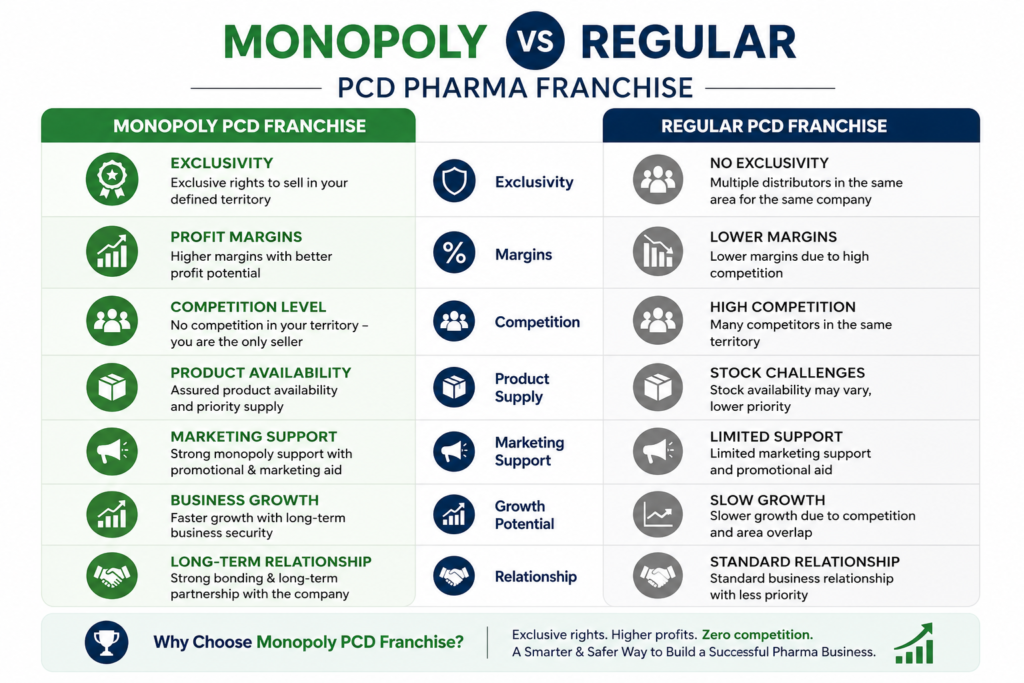
Understanding the distinction is critical before you invest a single rupee:
| Point | Regular PCD franchise | Monopoly PCD franchise |
|---|---|---|
| Territory | May be shared with other partners | Assigned to one partner in writing |
| Same-brand competition | Possible | Removed within the agreed territory |
| Effort pays off for | Whoever gets there first | You, for the agreement period |
| Pricing discipline | Harder to hold | Easier to hold across your chemists |
| What to verify | Little | Boundaries, duration, renewal terms |
Monopoly removes competition from your own company’s other franchisees. It does not remove competition from other brands, which is where most of your selling effort goes.
Monopoly Rights: What Written Exclusivity Covers and Its Limits
Exclusivity is only as strong as the agreement. Before you sign with any company, check the following.
What a good agreement should state
- The exact territory: district, pin codes or state, not just “Punjab region”.
- Which products or divisions the exclusivity applies to.
- The duration, and the conditions for renewal.
- That the company will not appoint another franchisee, distributor or marketing partner for the same products in your territory.
Where exclusivity usually has limits
- Many agreements link exclusivity to a minimum purchase or sales target. Missing it can end your rights.
- Hospital tenders, institutional supply and government business are sometimes carved out.
- Online and e-commerce sales are often treated separately.
- Territory rights apply to that company’s brands only. Other companies in the same market remain competitors.
If a company promises monopoly on a phone call but is reluctant to put territory and exclusivity in the agreement, treat that as a warning sign. You can also ask for territory availability for your district before paying anything.
Benefits of a Monopoly PCD Pharma Franchise
Protected relationships. The doctors you build trust with will not be approached by another distributor of the same brand.
Pricing control. With one partner in the area, there is less pressure to undercut each other on the same product.
Low manufacturing risk. You do not run a plant or hold product licences. The company manufactures; you market and distribute.
Room to grow. You can begin with a limited product range in one district and add products, medical representatives and territories as your sales justify it.
Brand infrastructure. You work under the company’s established product approvals and quality systems instead of building them yourself.
Profit is not guaranteed by any of this. Results depend on your territory, product mix, doctor coverage and working capital.
Monopoly PCD Pharma Franchise Investment: A Realistic Cost Breakdown
The most common question is what a monopoly PCD pharma franchise costs. The honest answer is that it depends on territory size and how fast you want to scale. The ranges below are typical for the Indian market; always ask the company for a written quotation.
| Cost item | Typical range | Notes |
|---|---|---|
| First stock order (the PCD franchise minimum order) | Varies widely by company | Ask for the minimum order in writing and check it is realistic for your territory |
| Drug licence | State fees plus professional charges | Wholesale licence needs suitable premises and a registered pharmacist or competent person, so costs and time differ by state |
| GST registration | Low or nil government fee | Mandatory once turnover crosses the applicable threshold |
| Working capital (first 3 months) | Depends on your credit to chemists | Often the biggest hidden cost |
| Promotional kit | Often supplied free or at low cost | Confirm what is included |
| Field staff | Monthly salary per MR |
What to ask before you commit
- What is the minimum order and is it a one-time or a recurring requirement?
- Are samples, visual aids and promotional tools free, or charged?
- Who pays freight?
- What is the policy on expired, near-expiry and damaged stock?
- Are there annual targets attached to the exclusivity?
A franchise that needs a very large first order before you have earned a single rupee is usually a cash-flow risk rather than an opportunity.
Licences and Documents You Need
- Drug licence (wholesale). Issued by the State Drug Control authority. Requirements on premises, storage and a qualified person apply.
- GST registration. Needed for invoicing and input credit; apply on the GST portal.
- PAN. For all business and tax purposes.
- Franchise agreement. Territory, products, exclusivity, targets, payment terms and termination.
- Optional: Udyam registration for MSME benefits, and FSSAI registration if you will supply nutraceuticals or food-category products.
Because rules and fees differ by state, confirm requirements with your State Drug Control office or a licensing consultant.
How to Choose a Monopoly Pharma Franchise Company in India
If you are comparing a monopoly pharma franchise company, use this checklist. Any genuine company should be comfortable answering every point.
- Manufacturing certification. Ask for copies of the manufacturing licence and WHO-GMP or other quality certificates, and check that the unit and the batch labels match.
- Product range that fits prescribing. Look for depth in the segments doctors in your area actually prescribe: general medicine, paediatric, gynaecology, cardiac and diabetic, dermatology, orthopaedic, and ayurvedic or nutraceutical lines.
- Written exclusivity. Territory, products and duration in the signed agreement, as covered above.
- Transparent pricing. A clear price list with PTR and PTS, so you can calculate your margin after freight and your own costs.
- Realistic minimums. An order size you can sell through within a reasonable stock cycle.
- Support that shows up. Test their response time before you sign. Ask about promotional material, product training and who your contact will be.
- Track record. Years in business, number of active partners, and whether you can speak to existing franchisees.
- Compliance. Promotion should follow the Uniform Code for Pharmaceutical Marketing Practices. Be cautious about any company that sells you on gifts or inducements to doctors.
Red Flags to Avoid
- Exclusivity promised verbally but missing from the agreement.
- A very high minimum order with no explanation.
- Reluctance to share manufacturing licence or certificates.
- No price list, or a price list that changes after you pay.
- The same territory offered to several people.
- No written policy on expiry, returns or termination.
- Slow or evasive responses before the sale, which usually get worse after.
High-Demand Segments to Consider
Choose segments based on what local doctors prescribe, not on trends alone.
- Cardiac and diabetic: long-term therapy and repeat prescriptions.
- Paediatric: frequent use and strong doctor loyalty once a brand is trusted.
- Gynaecology: supplements and maternal health products with steady demand.
- Dermatology: a high volume of outpatient consultations.
- Nutraceuticals and protein supplements: growing demand, with category-specific regulations to check.
- Ayurvedic and herbal: rising consumer interest and AYUSH support.
India’s pharmaceutical market was valued at about USD 61.36 billion in 2024 and is projected to reach USD 174.31 billion by 2033, according to IMARC Group. Rising chronic disease and expanding access in smaller cities support long-term demand. That growth benefits the category, but your own result depends on execution in your district.
Why Partner With Pharvax Biosciences?
Pharvax Biosciences is a pharma company headquartered in Panchkula, Haryana, offering PCD pharma franchise opportunities across India. Here is what you get when you apply for a Pharvax monopoly PCD franchise:
- Written territory agreement defined by district or pin code.
- Product portfolio across tablets, capsules, syrups, injectables, soft gels, drops, ointments, protein powders and more, in cardiac and diabetic, paediatric, gynaecological and ayurvedic ranges, plus the Medivaxia division. [VERIFY – current SKU count]
- Quality credentials: [VERIFY – manufacturing partner, WHO-GMP / ISO certificate details, drug licence number]
- Promotional support: visual aids, MR bags, catch covers, prescription pads
- Clear price list with PTR and PTS shared before you commit.
- Entry point: ₹20,000 minimum first order, payable in advance
How to enquire
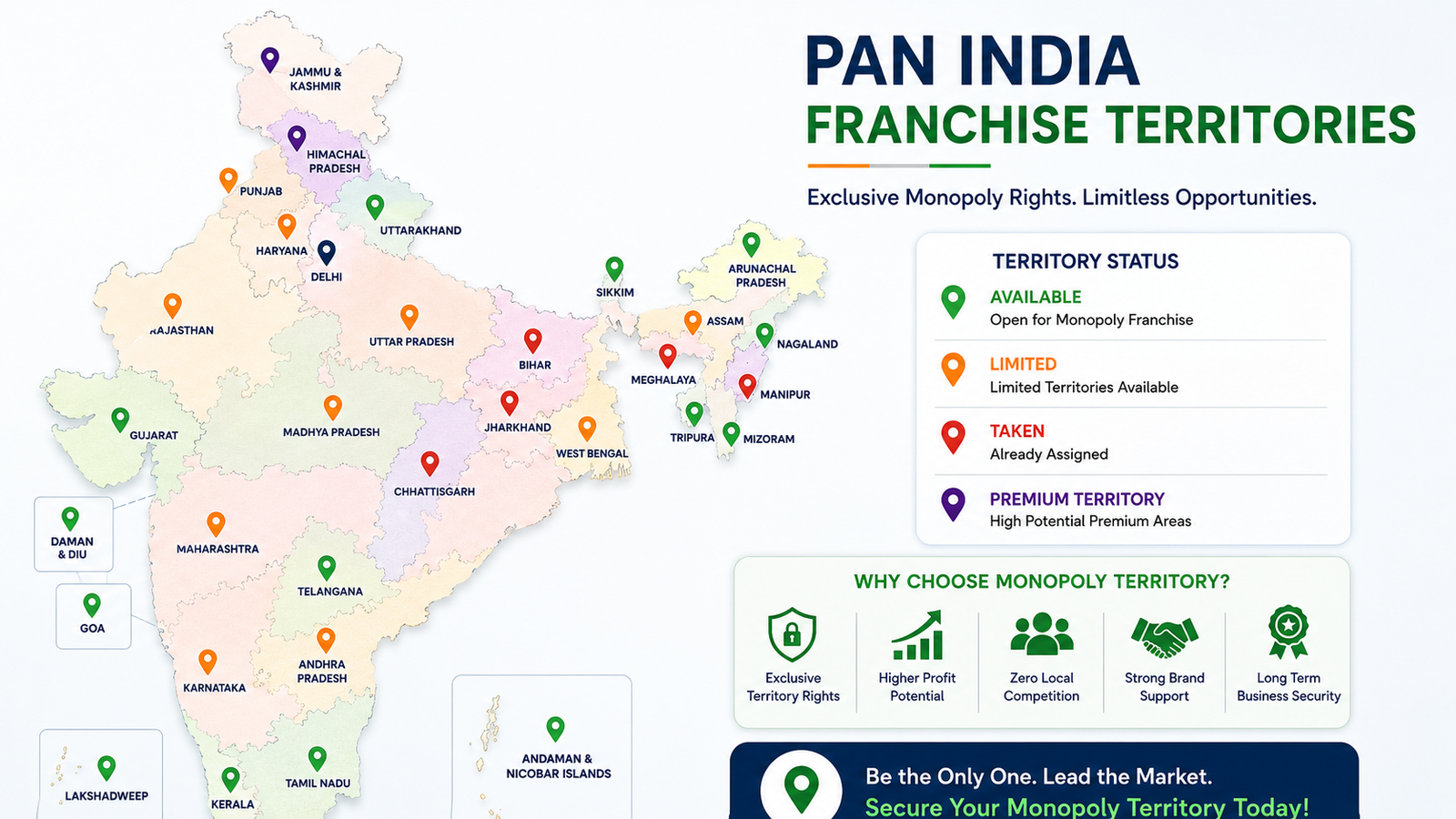
- Share your district and state, and check territory availability.
- Tell us whether you already hold a drug licence, have applied, or need guidance.
- Receive the product list, price list and draft agreement.
- Review the terms and speak to our team before you decide.
Call / WhatsApp: +91-9888895871 Email: pharvaxbio@gmail.com Office: Plot No. 138, Second Floor, Phase 2, Industrial Area, Panchkula, Haryana 134113
Check territory availability and get the product list
Frequently Asked Questions
What is a PCD pharma franchise on monopoly basis?
It is an arrangement where a pharma company gives one partner exclusive rights to promote and distribute its products in a defined territory. No other franchisee of the same company should operate there during the agreement.
How much does a monopoly PCD pharma franchise cost?
It depends on the company, product range and territory. Your main costs are the first stock order, drug licence, working capital and any field staff. Ask the company for a written minimum order and full cost list before you pay.
Is monopoly really exclusive?
Only if it is in the signed agreement. Confirm the territory, products, duration and any targets that could end exclusivity.
What is the PCD franchise minimum order?
It varies by company. Check whether it is a single starting order or a recurring requirement, and whether it suits the size of your territory.
Which documents do I need?
A wholesale drug licence, GST registration, PAN and a signed franchise agreement. FSSAI is needed for some nutraceutical products.
Can I start without pharma experience?
Yes, there is no degree requirement for the franchise itself, but the drug licence requires a qualified person. Experience as an MR or pharmacist speeds up your first year.
Is a monopoly PCD franchise profitable?
It can be, but returns are not fixed. Margins depend on pricing, freight, credit given to chemists and how actively you cover doctors. Calculate your margin from the price list before committing.
How long does it take to start?
Most of the time goes into the drug licence, which varies by state. Agreement and first dispatch can be quick once documents are ready.
Monopoly franchise or third party manufacturing?
In a franchise you market the company’s brands. In third party manufacturing you build your own brand and product range, which needs more capital and regulatory work. See our third party manufacturing page if you want your own brand.
Conclusion
A monopoly PCD pharma franchise is worth it when the exclusivity is written, the numbers are transparent, and the company supports you after the sale. Check the territory, the minimum order, the certificates and the price list first. Then choose the partner who answers every question plainly.
If you want to explore a Pharvax monopoly PCD franchise for your district, contact our team for territory availability and the current product list.